
Applying the 6 C’s framework for first party data success
Whether you're in a startup, small business, or large corporation, customer data can drive financial growth for your company and accelerate your career. I’ve seen small businesses leverage it to punch well above their weight and ASX-listed companies lag behind.
But the real value doesn’t come from simply having a data strategy. It's about embedding it into your everyday operations. By building and continually enhancing a single customer view, you can personalise experiences, optimise marketing efforts and boost profitability. Over the next 5 minutes, I’ll show you how to turn data into a genuine advantage for you and your company.
So, how much is data worth?
A well-executed first-party data strategy can yield significant financial rewards. A 2020 McKinsey study revealed that companies with strong data strategies see 5 to 6 times higher profitability than those without. The value is also evident in high-profile acquisitions:
Facebook’s $19 billion acquisition of WhatsApp: WhatsApp’s data-rich user profiles justified the purchase price despite annual revenue of just $10m.
Microsoft’s $26.2 billion purchase of LinkedIn: LinkedIn’s 400 million user profiles and employment data added billions in value.
Zillow’s $50 million acquisition of StreetEasy: 1m monthly unique visitors showing high intent property search behaviour.
Each of these deals averaged a very similar $40-$60 per profile, indicating exactly how much each record can contribute to a company's valuation. These companies weren’t just buying customers; they were buying rich datasets that power personalised experiences and long-term engagement.
But it's not just the big players who are reaping the benefits. Smaller businesses in Australia and New Zealand are also dipping their toes in the data pool:
Narellan Pools (Australia): This Australian swimming pool builder utilised big data to drive marketing that achieved a revenue-to-expenditure ratio of 54:1.
Salesforce Survey (Australia and New Zealand): A recent Salesforce survey revealed that 88% of Australian small and medium businesses and 95% of New Zealand SMBs using artificial intelligence (AI) report increased revenue.
A simple framework for strong data foundations
AI gives early adopters a competitive edge, but the long-term advantage lies in the data itself. After all, AI is only as effective as the data that powers it, and how well those insights are embedded within the business.
Netflix exemplifies this by combining its first-party data into a single customer view and embedding it directly into its product, continually refining its models with new information to enhance the user experience. Using viewing history, preferences, and behaviour, it personalises content recommendations, keeping users engaged for longer. As a result, Netflix users average more than 2 hours of content daily - an engagement level that far surpasses traditional TV’s average of just 30 minutes.
Building Netflix-like data capabilities starts with laying the groundwork using the 6 C’s.
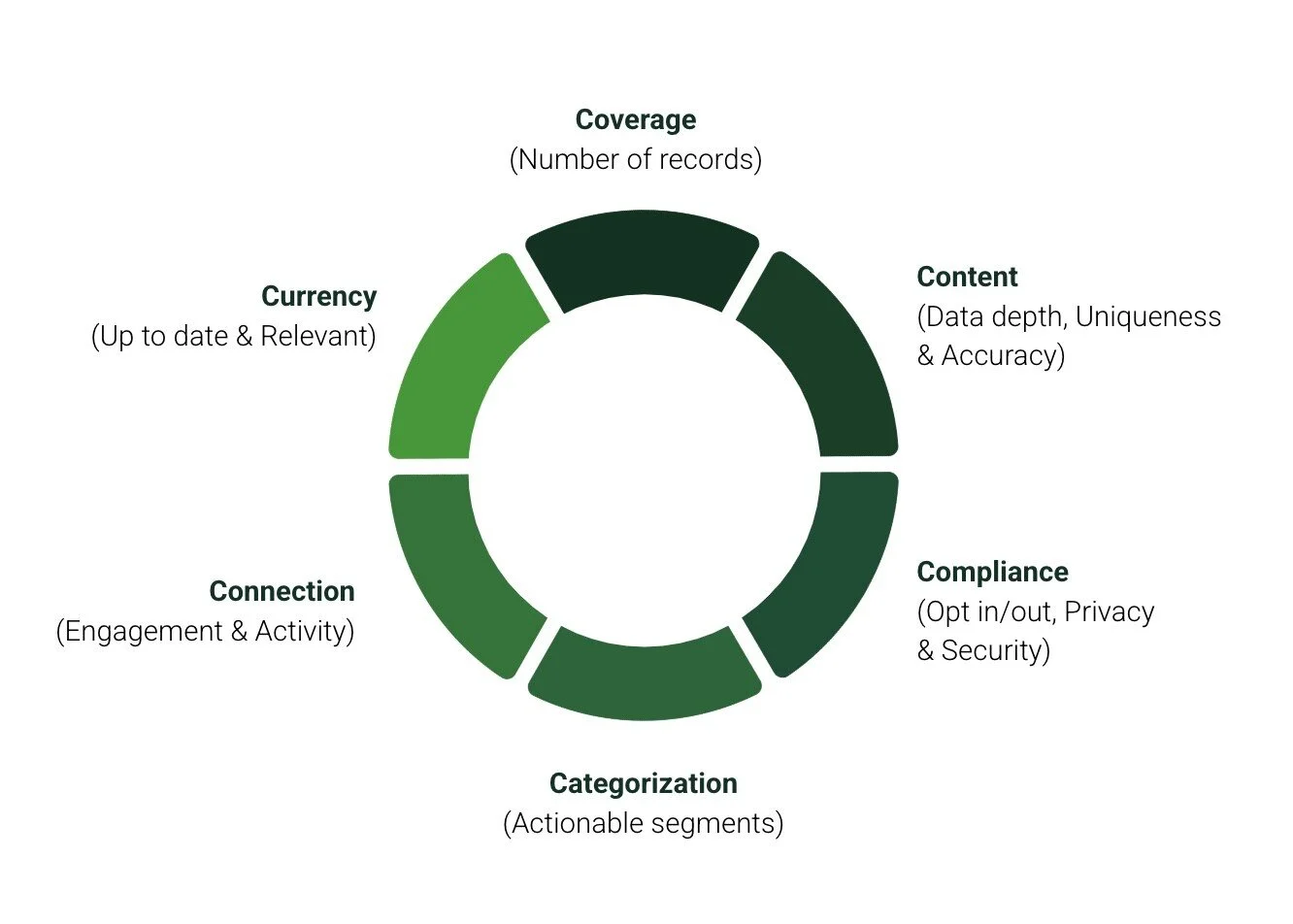
6 C's framework for a valuable database
Coverage: The breadth of your data. More records provide more scale and impact
Content: The richness and accuracy of your data. Think of each record as a row, and each column being a piece of content attached to each record
Compliance: Ensuring your data collection follows privacy regulations, building trust with customers
Categorisation: Organising your data to make it easy to access and act upon, and grouping people into segments
Connection: Maintaining an ongoing conversation with your database records, ensuring it’s tailored to each segment
Currency: Keeping your data up to date ensures it remains relevant and actionable
By focusing on these 6 C’s, you’ll ensure your data is not only high quality but also actionable, driving smarter marketing and better customer experiences.
Start small with an iterative approach
Here’s how you can take the 6 C principles and apply them to your daily work, improving both your job role and company success. Start small, build confidence, and expand your approach as you test and learn. Just like going to the gym, it's more important to build momentum and consistency than going all in short term and not delivering after.
Coverage & Content: Begin with the basics, capturing explicit data such as customer contact details and demographics from website forms or purchase records. From there, you can append third-party data (e.g. Census) and incorporate implicit signals (e.g. digital body language) by tracking behaviours like email opens, website and social media engagement. Over time, integrate more advanced approaches like lead scoring, product usage patterns and financial data to personalise experiences in real-time.
Compliance & Categorisation: Start by segmenting customers using simple criteria like demographics or purchase history. Next, refine your approach by grouping audiences based on behavioural patterns such as frequent visitors versus one-time buyers. As your strategy matures, introduce propensity models to predict the likelihood of key actions, such as making a purchase, churning, or subscribing to a newsletter. These insights enable you to tailor marketing efforts and proactively engage high-value or at-risk customers with the right messaging at the right time.
Connection & Currency: Begin by using basic time-based triggers, such as automated welcome emails or reminders for repeat purchases. As you gain confidence, implement behavioural triggers such as re-engagement campaigns for inactive users or upsell prompts based on past purchases. The most advanced stage involves predictive analytics to anticipate customer needs, optimise sales opportunities, and offer personalised recommendations before customers even ask.
By leading with this mindset, you’ll not only deliver results for your company but also strengthen your role as a data-driven leader, ultimately increasing your value to the business.
Elevate your data strategy today
A first-party data strategy is about much more than collecting basic information. It’s about creating rich, actionable insights that help build a lifetime value rather than a short-term transactional approach. By building a unified customer profile and embedding data-driven processes into your operations, you can unlock the full potential of your data. Remember that the real value comes from how you execute. Companies that succeed don’t just collect data, but instead know how to leverage it to create personalised experiences, deepen customer relationships, and drive sustainable growth.
So, ask yourself: How are you using first-party data in your role? Are you embedding it into your daily processes to drive customer value, improve business outcomes, and accelerate your career?
Start small: Map out how you can implement the 6 C’s in your role today and test your approach. Refine your strategy through iterative experimentation as you gather more data and insights. The companies that get this right now will lead their industries tomorrow, and by taking action today, you can be one of those leaders.
