
What can we learn from other industry playbooks?
Which growth lever is the go-to for your industry? In this month's edition of The Happy Customer, I have a crack at comparing five major sectors to better understand their mode of differentiation and what we can learn from their application. The headlines? Digital maturity varies dramatically by sector, pricing strategy directly reflects market commoditization, and personalisation has become universally critical, even in the most traditional industries.
Findings
I evaluated each industry across five modernised growth levers (inspired by the classic 5 P's), scoring from 1 (negligible) to 10 (critical). Here's how it landed:
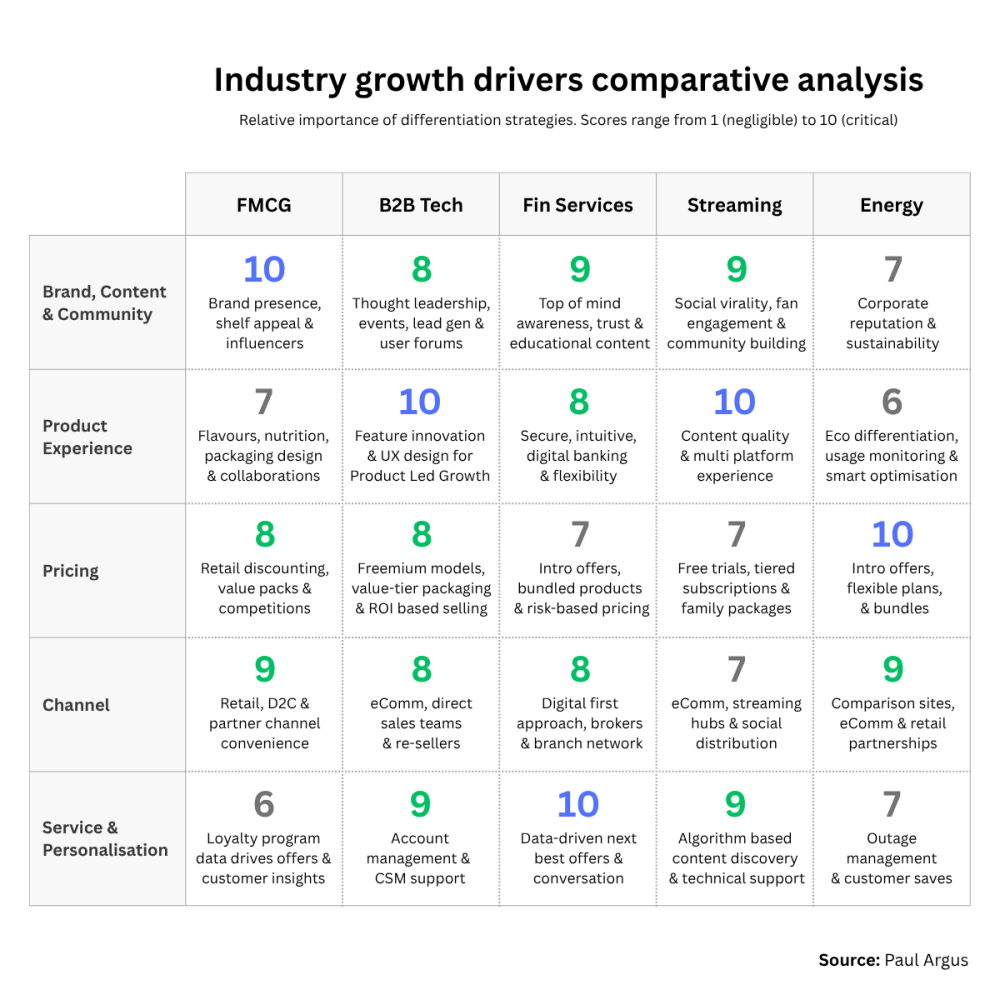
Comparative industry growth levers
B2B Tech: The product-led growth champion
Build something amazing, then support your users relentlessly. The rise of product-led growth has made exceptional UX the primary driver of customer acquisition and retention. Service & personalisation follow closely, as account management and customer success have evolved from support functions to revenue engines that drive expansion revenue.
Financial Services: The personalisation powerhouse
Data-driven personalisation wins by delivering the right offer at the right life moment. Service & personalisation have become the ultimate competitive advantage through next-best-action recommendations and personalised offers. Brand, content & community remain critical in an industry built on trust, where top-of-mind awareness and educational content drive customer acquisition and retention.
Streaming: The content and community king
Create entertainment experiences people can't stop talking about. Product experience through content quality and multi-platform user experience is non-negotiable, with the Netflix interface being as important as their original series. Brand, content & community drive organic growth through social virality and fan engagement that turn shows like "Stranger Things" into cultural phenomena.
FMCG: The brand and retail relationship masters
Brand presence and shelf space equal market share. Brand, content & community through packaging design, shelf appeal and influencer partnerships remain critical, with social commerce amplifying the importance of brand building. Channel strategy continues to drive market share through retail relationships, D2C capabilities, and partner channel convenience.
Energy: The pricing and channel specialists
Pricing flexibility and low-friction acquisition dominate in a commoditised market. Pricing through flexible plans, bundling options, and promotional offers serves as the primary competitive weapon. Channel strategy drives customer acquisition through comparison sites, eCommerce platforms, and retail partnerships in a market where switching is common.
Cross-industry learning opportunities
Value lies in understanding what other industries do exceptionally well and adapting those approaches to your context. Here's what we can learn from each other:
B2B Tech's product-led growth mastery demonstrates how an exceptional user experience can become your primary acquisition engine. Their customer success programs turn users into advocates who drive organic growth. Traditional industries can adopt this by focusing relentlessly on product design and the post-purchase experience.
Financial Services' data sophistication showcases the power of predictive analytics to create proactive customer experiences. They've mastered using behavioural data to anticipate needs before customers recognise them. Other industries can apply this by better investing in data capabilities that enable next-best-action recommendations.
Streaming platforms' content and community excellence prove that quality content combined with social virality creates organic growth engines. They understand that fan engagement around content reduces churn more effectively than any retention campaign.
FMCG's brand-building fundamentals illustrate how packaging design and visual identity can drive purchase decisions at the point of sale. They've mastered using design as a brand differentiator in crowded retail environments. B2B companies, for example, sometimes underestimate how much brand strength and thought leadership can drive competitive advantage, even in functional purchase decisions.
Energy companies' pricing sophistication in commoditised markets offers lessons for any industry facing pricing pressure. They've elevated their pricing strategy through bundling, flexibility, and promotional tactics while pioneering sustainability-driven differentiation.
The convergence trend reveals that all industries are being shaped by common forces: accelerating digitalisation, rising expectations for personalised experiences, and the growing importance of seamless customer journeys.
Summary
Three universal trends are reshaping every sector. Digital maturity varies dramatically, while B2B Tech and Streaming operate as digitally native industries, traditional sectors like FMCG and Energy are navigating digital transformation, creating both challenges and opportunities. Personalisation is becoming universally critical, with companies across all industries investing heavily in data-driven customer experiences. Pricing strategy directly reflects market dynamics - the more commoditised the market, the more sophisticated the pricing approach.
There's no universal growth playbook, but there are universal principles. Understand your industry's unique dynamics, focus resources on the levers that matter most in your context, and build capabilities that position you for the digital, personalised future. The companies that will win are those that excel at their natural strengths while borrowing the best practices from industries that have already mastered the capabilities they need to develop.
